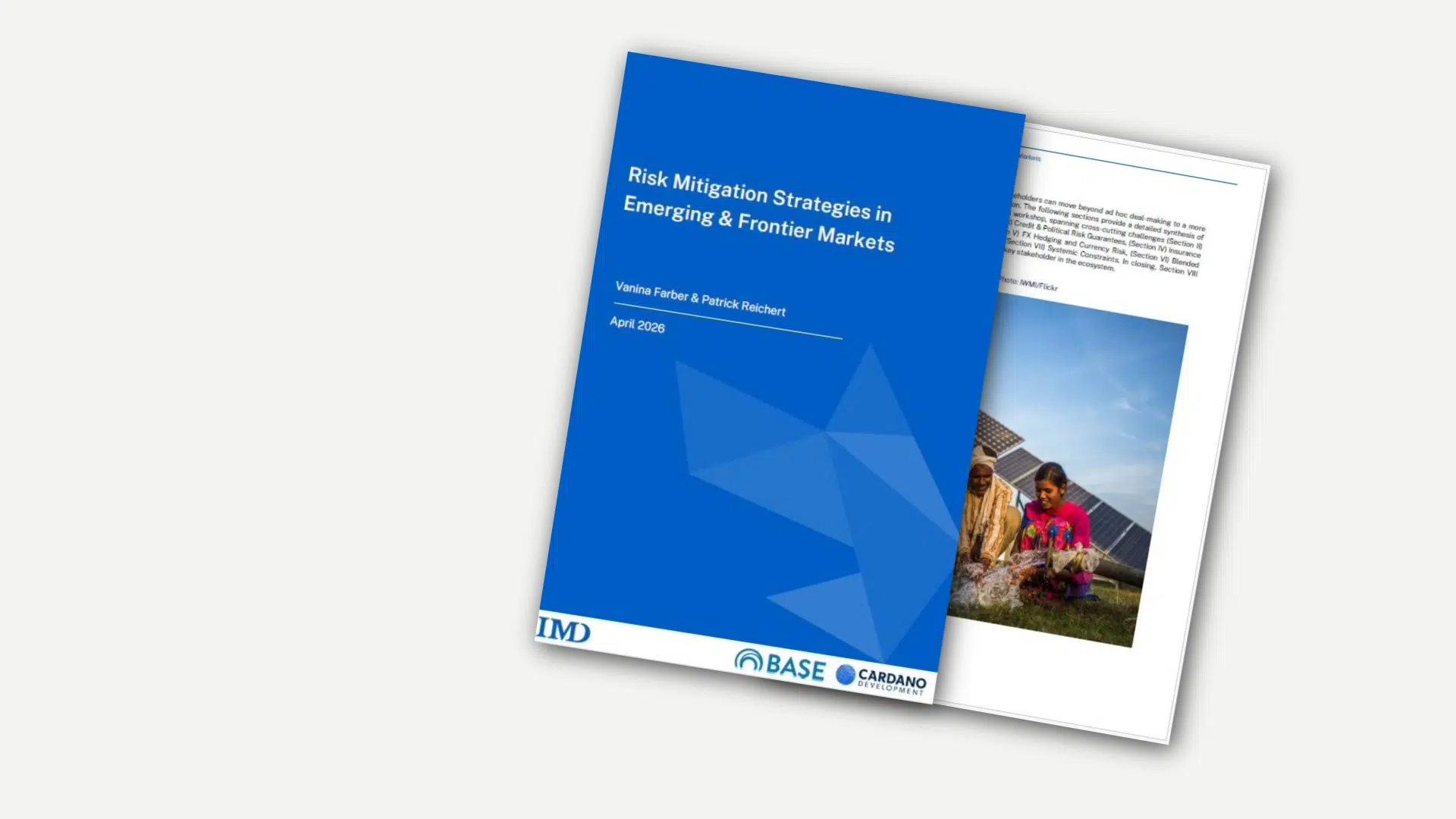
Emerging and frontier markets face an annual financing gap of USD 4–4.3 trillion to achieve sustainable development and climate goals, while traditional aid and investment flows remain constrained. Closing this gap will not be achieved by mobilizing more capital alone, but by strengthening the risk architecture needed to attract private investors at scale.
Unlocking private capital
At Building Bridges 2025, the BASE Foundation, Cardano Development, UNDP Rome Centre, and IMD convened nearly 100 experts to examine how targeted de-risking strategies can unlock private capital for climate and nature solutions in developing economies. Discussions highlighted persistent barriers: risks are often misperceived rather than mispriced, pre-investment support is poorly aligned with market realities, and weak risk-sharing and liquidity mechanisms deter large-scale commitments.
Participants identified a portfolio of proven tools—from guarantees and insurance to currency hedging and blended finance—that can unlock investment when deployed systematically.
Inside the report: What you’ll discover
- How de‑risking strategies can unlock private capital for climate finance in emerging and frontier markets
- Closing the sustainable finance gap: innovative tools to mobilize private investment at scale
- Blended finance, guarantees, and insurance: practical solutions for investing in developing economies
- Mobilizing private capital for climate and nature solutions through smarter risk mitigation
Explore detailed insights
Download the full report to explore the detailed insights, case examples, and actionable recommendations for donors, policymakers, DFIs, and private investors seeking to scale impact and mobilize capital where it is most needed.






Jerry Davis examines prediction market risks and explains why these politically backed platforms may resemble high-stakes casinos more than stock markets.

Increased collaboration shifts employees’ political ideologies and brings business benefits.

The era of unchecked expansion has passed – for Søren Westh Lonning, CFO at FinTech Pleo, the challenge now is to drive balanced, disciplined growth.

The case investigates the supported search fund model pioneered by Novastone Capital Advisors (NCA) through which mid-career executives can achieve their dreams of becoming entrepreneurs though the acquisition of an SME. NCA provides support throu...
Research Information & Knowledge Hub for additional information on IMD publications
Research Information & Knowledge Hub for additional information on IMD publications
Research Information & Knowledge Hub for additional information on IMD publications
Research Information & Knowledge Hub for additional information on IMD publications
Research Information & Knowledge Hub for additional information on IMD publications
Research Information & Knowledge Hub for additional information on IMD publications
Research Information & Knowledge Hub for additional information on IMD publications
Research Information & Knowledge Hub for additional information on IMD publications
Research Information & Knowledge Hub for additional information on IMD publications
Research Information & Knowledge Hub for additional information on IMD publications