“It’s not primarily a pipeline problem.
It is a system design failure.”
Women’s representation in executive roles is falling
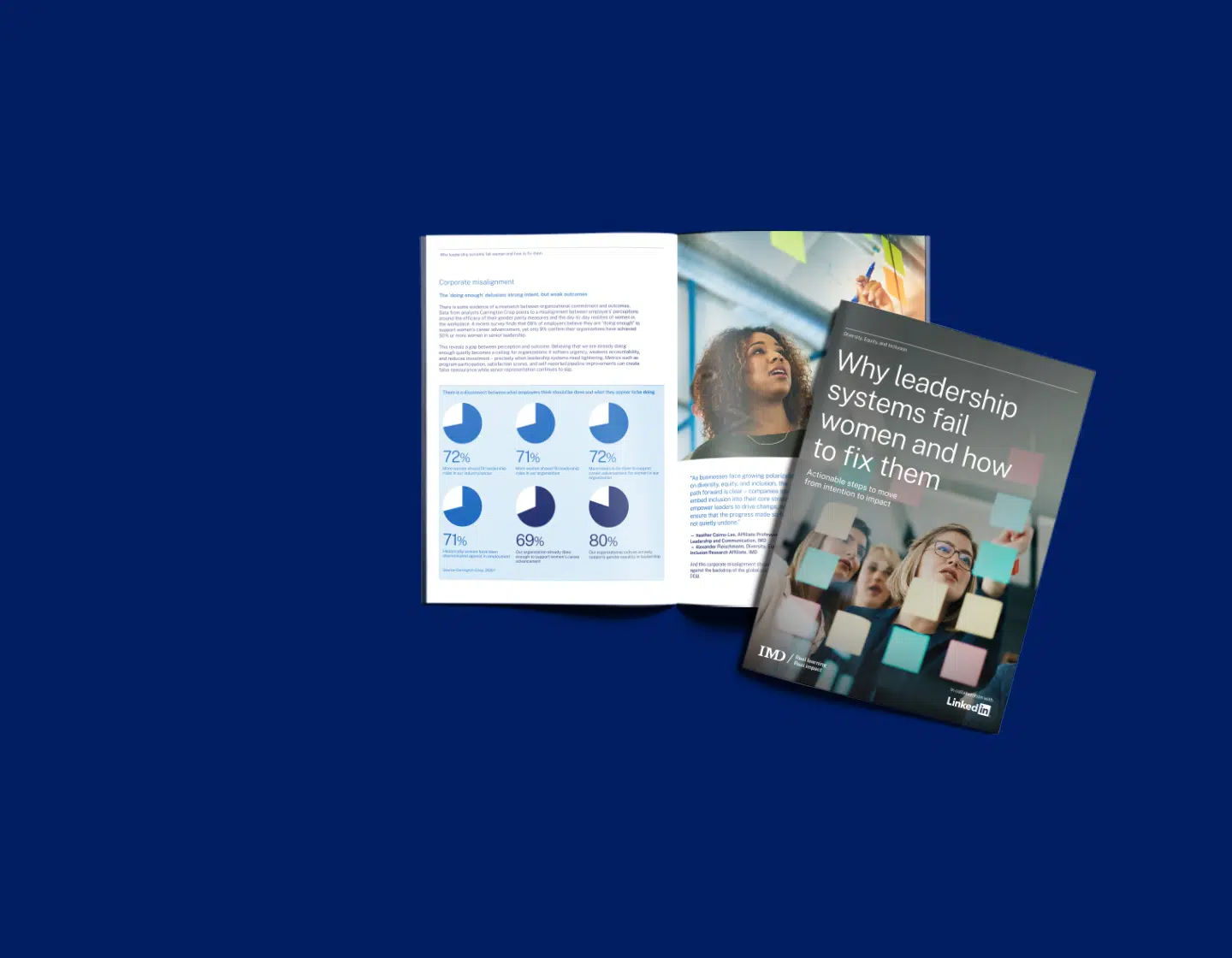
Despite decades of progress and significant investment in leadership development and gender equity, women’s representation in executive roles has dropped below 31% entering 2026. This decline is not a pipeline problem; it is evidence of leadership systems that no longer reflect the realities of a changing economy. Structural barriers continue to block women’s advancement, including limited access to executive learning, outdated succession processes, restricted feeder role pathways, and inconsistent sponsorship practices. At the same time, workforce exits, stalled DE&I momentum, and widening gaps between employer intentions and outcomes are compounding the issue.
Redesign systems to convert capability into power
Yet the capabilities organizations say they need most: adaptability, cross domain experience, collaborative leadership, and human judgment, are increasingly found among women leaders. What remains missing is a leadership architecture that converts capability into power. As AI accelerates skill disruption and economic volatility grows, organizations that fail to redesign these systems face rising succession risk and declining competitiveness.
Unlock the proven benefits of gender balanced leadership
This report offers practical, high impact recommendations to help employers unlock the proven benefits of gender balanced leadership. It outlines how to strengthen sponsorship, expand access to executive education, and address deeper system level failures. Central to this work is the “Power Triad”—succession slates, feeder roles, and sponsorship—which must be rebuilt to move organizations from intention to lasting impact.
From intention to lasting impact: the Power Triad
- Succession slates: Maintain visible, accountable, gender‑balanced succession slates for all senior roles, reviewed quarterly by executive committees and boards.
- Feeder roles: Clearly define the executive feeder roles that lead to senior leadership and publish annual gender access rates, treating persistent imbalance as a governance risk.
- Sponsorship: Make sponsorship a formal leadership obligation by measuring, evaluating, and rewarding it as part of executive performance.
This report is enriched by the findings of a proprietary survey of HR and L&D leaders conducted by IMD, along with a case study that showcases executive education for female leaders supported by inclusive leadership progression structures within HEINEKEN.
Authors
Ginka Toegel, Professor of Organizational Behaviour and Leadership, IMD
Heather Cairns-Lee, Affiliate Professor of Leadership and Communication, IMD
Alexander Fleischmann, Diversity, Equity, and Inclusion Research Affiliate, IMD



Physician and Paralympian William Tan shares leadership lessons on resilience, adaptability, overcoming adversity, challenging assumptions and finding purpose

Learn how aikido leadership principles help you resolve workplace conflict, respond to resistance, and turn difficult conversations into collaboration.

Explore the Magnificent 7 of scaling: strategy, organization, and leadership practices that drive successful growth.

Protect thinking time to improve leadership under pressure. Learn how delegation, recovery, and clear boundaries support better decisions when it matters.

Is your calendar run by others or by you? Use this leadership diagnostic to reclaim time, sharpen priorities, and strengthen decision making.

The business case for living longer explored by IMD: how longer lifespans reshape work, healthcare costs, and competitive advantage.
Could government borrowing, AI investment and falling corporate profits trigger a global financial crisis? Explore the pressures and risks for business.

Discover two practical toolkits to keep your multigenerational family business aligned: governance agreements, councils, and clear exits.

True or false? Digital ecosystems — challenge conventional thinking with findings from the IMD-AVEVA report and discover where real value lies.

While the CHRO role has evolved into a strategic position, the move to CEO remains rare. IMD’s Robert Hooijberg examines why and how we can change it.
Research Information & Knowledge Hub for additional information on IMD publications
Research Information & Knowledge Hub for additional information on IMD publications
Research Information & Knowledge Hub for additional information on IMD publications
Research Information & Knowledge Hub for additional information on IMD publications
Research Information & Knowledge Hub for additional information on IMD publications
Research Information & Knowledge Hub for additional information on IMD publications
Research Information & Knowledge Hub for additional information on IMD publications
Research Information & Knowledge Hub for additional information on IMD publications
Research Information & Knowledge Hub for additional information on IMD publications
Research Information & Knowledge Hub for additional information on IMD publications